
Most subscription business founders are drawn to the business model because it brings recurring revenue and customer loyalty.
But there’s a lot more to manage, including billing logic, fulfillment cycles, churn management, and changing customer expectations.
Traditional ecommerce doesn’t have to deal with most of this. Subscription businesses do from day one.
Let’s take a deeper look at the main differences between these two business models.
Revenue and billing complexity
Recurring billing cycles add a layer of operational pressure that standard ecommerce doesn’t have to deal with.
Subscription business owners have to manage:
- Renewals.
- Plan changes.
- Trial periods.
- Skips.
- Pauses.
- Prepayments.
- Payment failures.
Each customer might be on a different plan, billing schedule, and set of entitlements, creating a complicated web of billing logic.
You need systems that can manage dunning flows, automatic retries, upgrade/downgrade paths, and dynamic proration, all without friction.
If there’s a problem with billing, you don’t just lose a transaction, you could lose a customer and future revenue. This, in turn, has an impact on overall subscription metrics like customer lifetime value (CLTV).
Most subscription platforms recognize this and now include built-in tools for flexible billing, retries, and custom plans.
But complexity still scales with volume and becomes a drag on your time if it is not automated.
Operational coordination: inventory, fulfillment, and scheduling
Standard ecommerce ships once and then resets.
Subscription e-commerce delivers again and again; each delivery must align with stock, shipping lead times, customer preferences, and renewal dates.
One customer might skip a month, another might add extras, and a third might cancel mid-cycle.
Multiply that across hundreds or thousands of subscribers, and you’re dealing with live inventory that’s constantly in flux.
You can’t rely on reorder logic. You need to accurately forecast demand while accounting for churn, skips, and pauses. One bad prediction can leave you overstocked or under-delivering to your best customers.
This level of coordination between billing, inventory, and fulfillment is what makes subscription logistics uniquely hard to manage manually.
Customer retention pressure and churn
Churn is a core issue for subscription ecommerce businesses. Even if acquisition is strong, losing 10% of customers per month can reduce your revenue.
Retention is about building systems that actively prevent churn, including:
- Smart cancellation flows.
- Pause options.
- Timely reminders.
- Targeted win-back offers.
In other words, retention isn’t a campaign. It’s part of your business’s infrastructure. And it has to run alongside every part of the customer journey, from onboarding to cancellation.
Personalization at scale
Subscriptions rely on ongoing customer relationships. These relationships are worth more and last longer when they are authentic and personalized.
When we say “personalization”, we’re not just talking about marketing emails. It should run through the entire customer experience.
What gets delivered, when, how it’s priced, and what’s recommended next can all be shaped by customer behavior, preferences, browsing habits, or purchase history.
Unfortunately, doing that manually doesn’t scale. As subscriber counts grow, the logic behind personalization needs to be built into your platform, or delegated to an AI that understands the context.
What Are Vertical AI Agents and Why Do They Matter?
Most AI tools on the market are broad by design. They’re built to serve as many industries as possible. But that also means they don’t understand the specifics of those industries or cannot handle complex tasks related to them.
For example, tools like ChatGPT are large language models (LLMs). They are trained on vast amounts of text data and use mathematical models to identify structure, meaning and patterns, as well as predict word sequences.
This enables them to understand, generate and process human language.
As a subscription ecommerce business owner, you could use ChatGPT to write a retention email using customer data.
But it couldn’t automatically find and analyze data, write the email, send the email, and monitor campaign analytics.
You could automate the process by connecting the apps used at each stage of the process.
However, these chains can be prone to errors. If one app makes a mistake or doesn’t integrate properly, then the whole process collapses.
Vertical AI agents are built for one domain
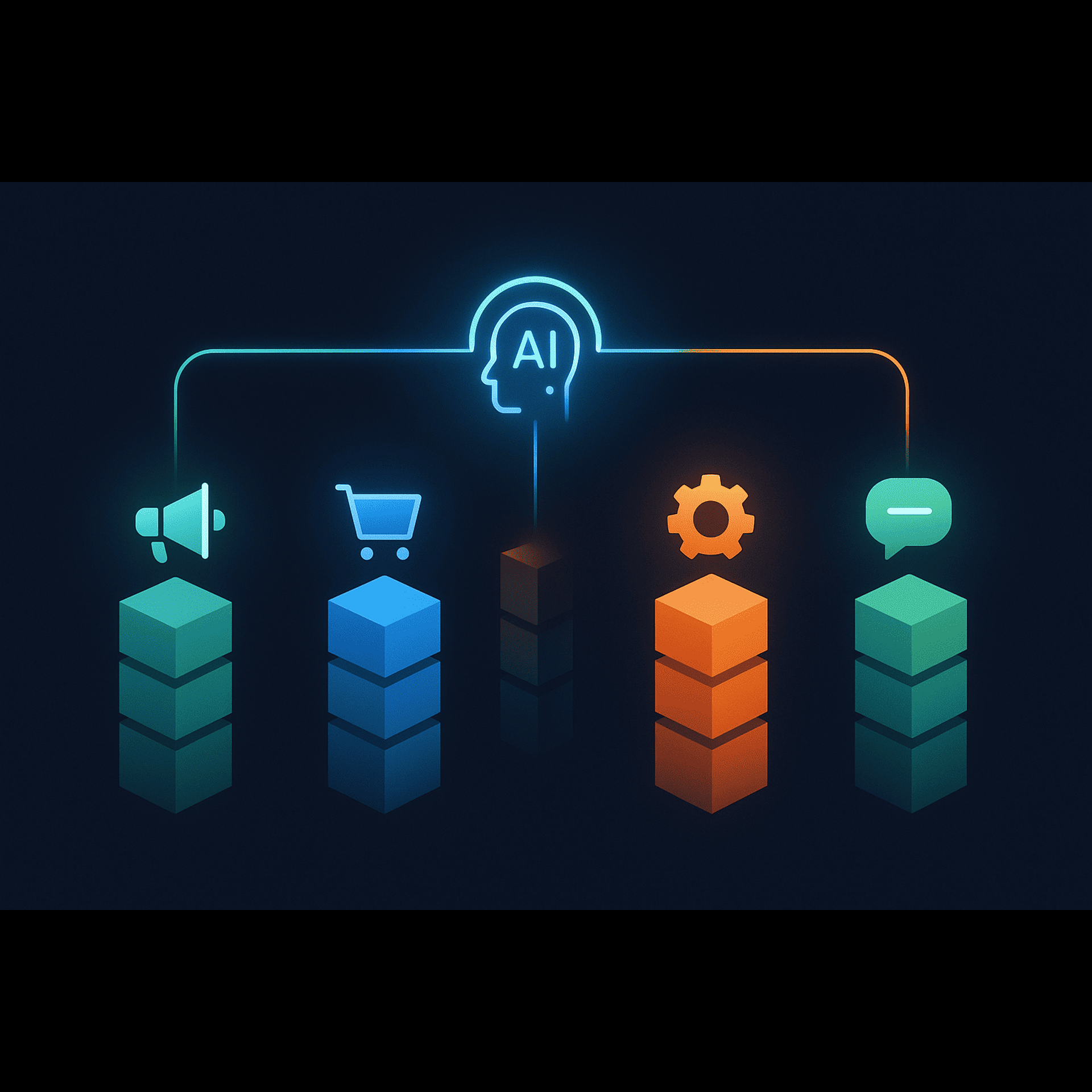
Vertical AI agents are different. Think of them as an LLM armed with three things:
-
Tools
Using our retention email example above, the AI agent might control an analytics package, an LLM, and an email marketing tool. Instead of being connected, these apps are managed by a single entity that is trained to use them.
-
Context
Vertical agents understand the logic and systems that enable a particular type of business to operate. So, for example, our retention campaign agent would understand churn patterns, the kinds of offers that reduce churn, and what a successful campaign looks like.
-
Data
The vertical AI would be able to access data on preferences, inventory, conversion rates, open rates, as well as customer data and use this to make informed decisions.
Vertical AI technologies are built to operate within a single business model. This gives them functional depth and makes them far more useful.
They can make decisions based on rules, data, and intent. This means they can do more complex tasks quickly and accurately.
Examples of Vertical AI Use Cases
In some industries, vertical AI agents have already proved their value.
Below are some examples.
Healthcare
In the insurance space, vertical AI technologies support tasks like claims processing by automatically reviewing documentation and estimating payouts.
For example, Omega Healthcare Management Services uses an AI-powered document-understanding agent to automate insurance claims and patient-billing workflows.
The system reviews medical documentation, extracts key details, and routes claims for processing automatically. Since launch, it has processed more than 100 million transactions, cut turnaround time by 50%, and achieved 99.5% accuracy, giving clients an estimated 30% ROI.
Law
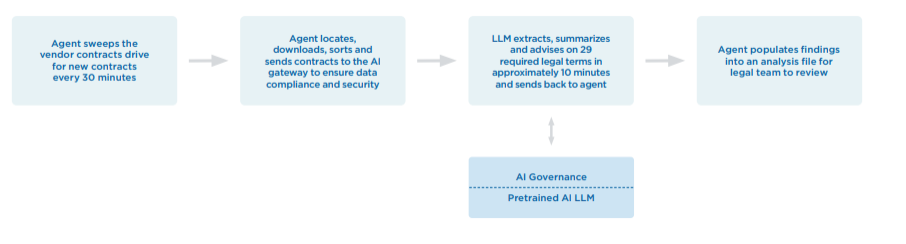
The legal industry uses vertical AI agents for contract review. A good example is the Vendor Contract Analysis Agent built by SS&C.
It automates vendor contract examination, extracting key clauses (like indemnity, intellectual property, cancellation terms), and summarizing long documents in minutes.
Ecommerce
Retail and ecommerce brands are adopting vertical AI agents to optimize shopping and operations. Recently, Walmart has started rolling out “super agents” that assist potential customers, employees, and suppliers.
These agents can manage orders, streamline supply-chain operations and create personalized experiences by suggesting relevant products. This is all part of Walmart’s strategy to expand its online sales. The video below explains more:

Why subscription ecommerce is the ideal use case
As mentioned, subscription ecommerce covers repeatable processes like billing schedules, renewals, plan logic, and fulfillment rules. These kinds of data-centered functions are perfect for AI.
With vertical AI agents, we can take this a step further.
We can give our agent context around:
- How subscription processes work.
- How they impact each other.
- The effect they will have on other processes, like customer relationships.
And then provide it with useful customer data like their:
- Plan type.
- Billing history.
- Individual tastes.
- Usage.
- Past user behavior.
Finally, we give it control over the different business tools, including:
- Marketing.
- Website content.
- Product descriptions.
- Carts.
- Subscription logic.
- Billing.
- Inventory.
- Fulfillment.
- Retention tools.
- Analytics.
This combination would enable the AI to determine what should happen next in any given process.
Say a customer skips a renewal:
- Should their subscription be paused?
- Should they get a retention email?
- Should inventory be adjusted?
The right answer depends on context. The same goes for a downgrade, a churn signal, or a mid-cycle plan change.
In subscription ecommerce, these kinds of decisions happen every day, at scale. And they’re exactly what vertical AI agents are built to handle.
They can respond fast, automatically, without input from human agents, and without getting it wrong.
Let’s take a look at a specific subscription ecommerce use case: building a website. We’ll use Subbly’s own vertical AI agent as an example of how this works.
Subbly’s Subscription Ecommerce AI Website Builder: A Vertical Agent in Action
(screenshot needed here)
Ecommerce website tools like Wix ADI or Shopify’s AI storefront generators are fine for getting a basic website live.
But they don’t understand how the industry works. Most founders end up stitching together half a dozen plugins just to make things functional, then manually configuring everything.
Similar to what we mentioned earlier, these third-party apps have limited functionality, don’t integrate well, and are often buggy.
The result: more work, more maintenance, and more room for error.
Subbly’s new website builder, on the other hand, is powered by a vertical AI agent.
It’s designed especially for subscription ecommerce companies. It understands how these types of businesses work and builds a website with the required features and automations built in.
You can do this using prompts, so you don’t need any coding expertise or expensive developers.
Best of all, it’s fast. You can put together a website with basic functionality in a matter of hours, rather than days.
Let’s take a deeper look at how this kind of agentic AI is better than the types of generators offered by Shopify and Wix.
Built for subscriptions, not just sales
Subbly’s builder is part of a platform purpose-built for subscriptions, meaning it recognizes the mechanics that define them, including billing intervals, skip options, renewals, and more.
That foundation means the AI can construct a storefront that’s ready for real transactions and long-term retention, not just one-off sales.
Merchants don’t need to retrofit billing or portal integrations, they’re generated as part of the initial build.
Funnel-ready from the first prompt
With a simple instruction like “Build a coffee subscription box with three tiers”, the AI can create a fully functional funnel: homepage, pricing table, product pages, checkout, and member portal, all linked to the underlying billing logic.
Each page is generated with the business model in mind. For example:
- Pricing sections automatically accommodate subscription tiers.
- Checkout pages default to recurring payment structures.
- Account areas are preconfigured for customer self-service.
This shortens the time between concept and launch from weeks to days.
Editable code and full design control
Subbly’s AI outputs editable, production-ready code. Users can refine the generated site using a visual point-and-click editor or by using code, adjusting copy, layout, and logic without starting from scratch.
With its intuitive interface, the builder is flexible enough for both founders building their first store and developers seeking deeper control.
Because the Subbly platform connects every part of your subscription program, including products, checkout, predictive analytics, and automation, anything the AI builds can link straight into those systems.
For example, a product page created by the AI can automatically pull live pricing data, trigger post-purchase email campaigns, or update subscriber analytics, without extra setup.
Connected to the lifecycle layer
The AI builder is part of the same platform that powers Subbly’s retention and automation tools.
These control things like:
- Cancellation-flow logic.
- Dunning retries.
- Win-back offers.
- Subscriber analytics.
These features currently run alongside the builder; however, it’s likely that they will be controlled by a vertical AI agent in the future too.
The agent already builds the storefront logic; the next step is allowing it to optimize that logic in real time by adjusting tiered pricing, testing retention offers, and refining cancellation flows automatically.
That’s what makes Subbly’s approach distinct; it’s not a visual generator or a generic assistant. It’s a vertical agent built for the logic, data, and economics of subscription ecommerce.
What Comes Next for Subscription AI?
Vertical AI agents like Subbly’s website builder are already transforming industries like subscription ecommerce.
But this technology is still in its infancy. It’s likely that in the coming years, these systems will develop even more powerful functionality.
Here are some of the developments we expect from subscription ecommerce AI agents in the near future:
- Adjust logistics: Modify shipping or delivery options based on churn or retention signals.
- Optimize messaging: Rewrite upsell or renewal emails weekly as inventory, demand, or seasonality change.
- Personalise experiences: Tailor pricing tiers or offers to each customer segment in real time.
Analyze performance: Detect friction points in the funnel and trigger automated fixes.
Build faster and smarter with Subbly
Subscription ecommerce has always been complex. Using standard AI tools to manage them can create extra work and technical issues.
Subbly’s AI Website Builder changes that. By embedding intelligence inside a platform built for subscriptions, it automates the heavy lifting that slows most founders down.
The result is a storefront that’s launch-ready from day one, with the structure and logic of a mature subscription model baked in.
It also points to something bigger. Subbly’s builder is an early signal of where ecommerce is heading: toward AI that understands specific business models and can run them automatically.
That change will reshape how online companies launch, scale, and operate.
Sign up for a free trial to find out how Subbly can help your subscription business reduce admin and boost monthly recurring revenue.
Already a customer? Then register for early access to our AI Website Builder and get ready to transform your business.


